Do you like history? Do you like other languages? Do you like the Bible? Well, so do I! This site is meant to be a reference point for anyone who wants to read the Bible in another language (specifically Latin or Spanish).
I’ve studied Latin for several years and Spanish for a couple years. I have experience translating several Books of the Bible from Latin. And I wrote a short book where I explain the language history that goes into the Latin New Testament (Available below).
Click here to view options for reading this book.
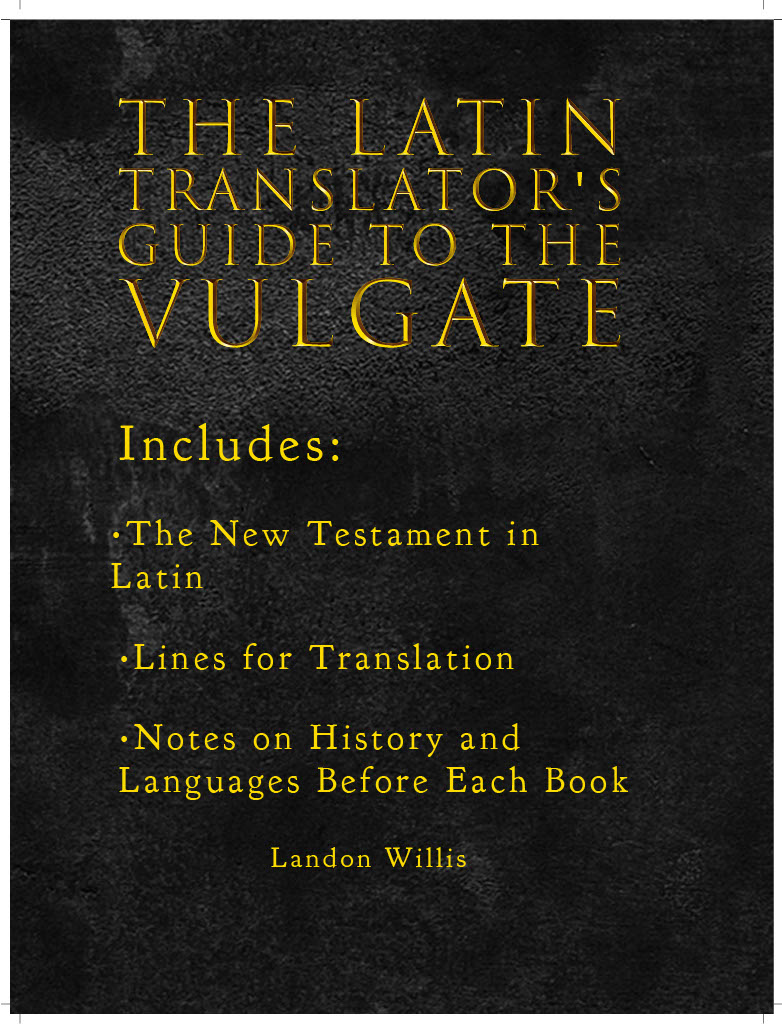
To help explain the purpose of this site and the book I wrote, I will go ahead and quote from that book’s introduction:
“’Repetitio est mater memoriae’ Repetition is the mother of memory.
This is a well-known motto in Latin classrooms across the world. Now of course you could find repetition by simply chanting verb endings or reading through Caesar’s Gallic Wars, or any number of other activities involving Latin. However, if you want to learn more Latin quicker, reinforce the Latin you already know, and have maybe a little bit of fun along the way, then I would highly recommend reading through the Bible in Latin, also known as the Vulgate.
I started doing this myself some time back at the suggestion of one of the people who helped teach me Latin. But when I began, I found that it was more difficult than expected, not only the task of translating itself, but also just finding a good way to keep record of my translation.
After looking to no avail for a printed version of the Vulgate that gave room for a translation after each verse, I decided to simply keep a disorganized binder full of notebook paper, where I would write each verse as its English translation. Whenever I wanted to add notes about etymologies or my own strange translations, I’d end up putting them on a separate page which quickly complicated matters even more.
Now, my case might very well be unique. Looking back, I could have kept the translations on my laptop, or I could have just been neater with my notes. Even so, I believe that it is a much greater convenience to have a single book, containing all of the Latin New Testament together with sections for notes, sections for translations, and (perhaps most importantly) sections giving a brief explanation of the minor historical and linguistic details of the Bible that many Christians and translators never get to learn.
And so, after having gone through the trouble of translating parts of the Vulgate into English, and after having seen what difficulties and annoyances I experienced, I decided to “write” this book. Most of these pages I did not write myself; rather they are a combination of the Vulgate New Testament and empty lines for translation. The rest is me writing the answers to questions I had as I was reading through the Vulgate, such as ‘Who wrote this?’ ‘When did this person write this?’ ‘To whom was this written?” ‘What interesting etymologies come from weird words used in this book?’ ‘What other interesting language tidbits are there in this Book?” etc.”
This whole site is meant to be a guide you can fall back on whenever you have trouble translating. The book is meant as a useful tool to keep track of your translations. And both are meant to give you more knowledge about the history and languages that went into the Bible.